

Brief description
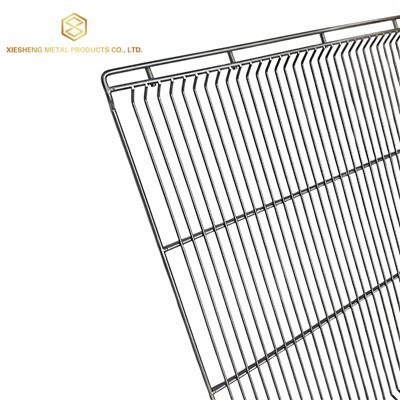
Refrigerator metal mesh refers to the metal mesh structure used in various parts of the refrigerator. It can be divided into three categories according to its function:
1. Cooling System Metal Mesh
•Condenser mesh: Located on the back or sides of the refrigerator. This black mesh structure dissipates the heat generated by the compressor to the external environment.
•Evaporator mesh: Built into the freezer/refrigerator compartment to absorb heat inside the box. Common forms include steel wire coil type and fin type.
2. Internal Structural Support Mesh
•Shelving grid: Stores food in layers, increases space utilization, facilitates classification, and allows air circulation.
•Storage basket: Used to store loose ingredients such as vegetables, fruits, drinks, etc.
3. Filtration System Metal Mesh
•Filter dryer: Located between the condenser and capillary tube. It filters moisture and impurities from the refrigerant. Contains 120‑200 mesh copper wire mesh.
Products Description
Refrigerator Metal Mesh – Manufacturing Process
1. Magnetic Filter
Magnetic filter removes iron filings and other magnetic impurities from the refrigeration system, protecting the compressor and ensuring clean refrigerant circulation.
2. Detailed Manufacturing Process
2.1 Raw Material Preparation
•Metal wire: The metal blank is drawn into a wire with the required diameter (0.3-5mm) through the wire drawing process.
•Board: Cut to required size, used for supporting structures or borders.
2.2 Molding Process
•Weaving: Divided into plain weave, twill weave, mat type, etc. Suitable for high-precision filtering and decorative mesh.
•Welding: Resistance welding or arc welding to join intersections. Used for shelving and load-bearing structures.
•Stamping: The plate is pressed into shape through a mold. Used for heat dissipation mesh fins and decorative mesh.
•Stretching: Stretching perforated sheets to form an expanded mesh to increase surface area.
2.3 Post-processing Process (Surface Treatment)
•Galvanized: Anti-corrosion, suitable for ordinary steel mesh.
•Plastic spraying / dipping: Commonly used PE, PVC materials, providing food-grade protection and aesthetic effects.
•Electrolytic polishing: Improves surface finish, suitable for high-end stainless steel products.
2.4 Assembly
Combined with supports and connectors to form a complete assembly.
3. Typical Process Flow
•Raw materials → drawing / shearing → forming (weaving / welding / stamping) → surface treatment → assembly → quality inspection → packaging.
This refrigerator metal mesh manufacturing process ensures that every component – from the magnetic filter to the final assembly – meets high standards of precision and durability. Whether you need a load-bearing shelf or a fine filtration mesh, our refrigerator metal mesh is built to last. Contact us today for custom sizes and specifications.
Material: performance and selection
01.Cooling system material
| Material | Features | Applicable Scenarios |
| Aluminum alloy (1060/6061) | high thermal conductivity (237W/m·K), light weight (about 1.2kg/piece), and good corrosion resistance | Mid-to-high-end refrigerator cooling net, fins |
| Galvanized steel plate | low cost, average thermal conductivity and requires anti-corrosion treatment. | Economical refrigerator cooling network |
| Stainless steel (304/316) | Excellent corrosion resistance, attractive appearance, poor thermal conductivity | High-end models, coastal humid areas |
02.Internal structural material
| Material | Features | Applicable Scenarios |
| Low carbon steel wire | Good strength, low cost, surface treatment required | Ordinary shelves and baskets, usually with PE dip coating |
| Stainless steel wire (304/304L) | Food grade, acid and alkali resistant, not easy to deform, easy to clean | Ordinary shelves and baskets, usually with PE dip coating |
| Copper alloy wire | Excellent thermal conductivity and antibacterial property, high cost | Special purposes such as shelves of high-end wine cabinets |
03.Filtration system material
| Material | Features | Applicable Scenarios |
| Copper mesh (Brass H68 / Pure copper T2) | Good thermal conductivity and antibacterial performance | Filter dryers |
| Stainless steel mesh (304/316) | Strong corrosion resistance | Precision filtration and long-term service |
Specifications: parameters and standards
1. Cooling network specifications
1.1 Dimensions parameters
•Condenser mesh: common sizes 550×75mm, 596×54mm, 918×54mm, thickness 0.3-1.5mm
•Fin spacing: 2-5mm. The smaller the spacing, the higher the heat dissipation efficiency, but it is easy to accumulate dust.
•Wire diameter: 1.4-1.5mm (steel wire coil type), fin thickness 0.1-0.3mm
1.2 Performance parameters
•High-end models: generally use 0.8mm thick aviation-grade aluminum alloy mesh, with a thermal conductivity of 237W/m·K, nearly 3 times higher than iron sheet
•Heat dissipation area: increased by more than 5% compared with traditional design, and materials reduced by more than 5% (low carbon and high efficiency standard)
2. Internal structural network specifications
2.1 Shelves standard parameters
•Wire diameter: 2.0-5.0mm (load-bearing), 1.0-2.0mm (lightweight)
•Grid size: commonly used 30×30mm to 100×100mm, density adjusted according to load-bearing requirements
•Standard size: 35×45cm, 40×50cm, 55×26cm, etc., can be customized
•Load-bearing capacity: each shelf of a commercial refrigerator can weigh 50-100kg
2.2 Surface treatment
•Coating thickness: PE/PVC dipped 0.3-0.8mm, uniform without bubbles, in line with food grade standards
•Color: white, black, silver, etc., can be customized
3. Filtration system specifications
3.1 Drying filter
•Diameter: standard 16mm or 19mm, length 85-150mm, wall thickness 1.0-1.2mm
•Filter precision: coarse mesh (inlet) 40-80 mesh, fine mesh (outlet) 120-200 mesh, filled with 4A molecular sieve in the middle
4. Purchasing and Application Guide
4.1 Cooling net selection
•Ordinary households: galvanized steel mesh is affordable and can be cleaned regularly
•High-end / humid areas: aluminum alloy or 304 stainless steel mesh, long life and low maintenance
4.2 Internal grid selection
•Household refrigerator: low carbon steel wire + PE dipped, cost-effective and easy to clean
•Seafood / preserved food: 316 stainless steel mesh, resistant to salt spray corrosion
4.3 Maintenance points
•Cooling net: clean regularly to avoid dust accumulation that affects cooling efficiency
•Internal grid: prevent sharp objects from scratching the coating and prevent metal from rusting after exposure
| Category | Application Scenario | Selection & Maintenance |
| Cooling net selection | Ordinary households | Galvanized steel mesh, affordable and clean regularly |
| Cooling net selection | High-end models / Humid areas | Aluminum alloy or 304 stainless steel mesh, long service life and low maintenance |
| Internal grid selection | Household refrigerator | Low carbon steel wire with PE dip coating, cost-effective and easy to clean |
| Internal grid selection | Seafood / preserved food storage | 316 stainless steel mesh, salt spray corrosion resistant |
| Maintenance points | Cooling net | Clean regularly to avoid dust accumulation affecting cooling efficiency |
| Maintenance points | Internal grid | Prevent coating scratches by sharp objects and metal rusting |
Although the refrigerator metal mesh is small, it is a key component to ensure the efficient operation of the refrigerator and optimize the internal space. Choosing appropriate materials and specifications will not only improve performance but also extend service life.
Hot Tags: refrigerator metal mesh 0, China refrigerator metal mesh 0 manufacturers, factory, refrigerator mesh, baskets for the freezer, holiday freezer basket, basket on top of fridge, egg basket fridge, freezer food box